Sunday, May 4, 2014

Speaking test - ketrampilan dan penilaian - PRONUNCIATION

Anda SIAP ngga?

Dapatkah anda megucapkan kosa kata bahasa Inggris dengan baik misalnya intonasi dan tekanan kata yg tepat dan 'natural'?

Apakah anda tidak bersulit penguji dalam memahami apa yang sedang anda katakan?

Kriteria penilaian untuk IELTS Speaking termasuk yg berikut :-

  • production skills (ketramplian produksi) - yaitu rhythm (irama), clarity (jelas), pauses (jeda) stress (tekanan), intonation (nada), dan sounds (suara);
  • communication skills (ketrampilan komunikasi) - yaitu fluency (lancar/fasih), coherence (runtut), confidence ("pd"),  style/appropriacy (sesuai dengan konteks);
  • language skills (ketrampilan bahasa) - yaitu grammatical range and accuracy (tatabahasa yg fleksibel dan tepat), vocabulary (kata 2). 
Salah satu kriteria untuk mengukur ketrampilan produksi anda adalah PRONUNCIATION

Nonton dan perhatianlah klip you-tube ini untuk memperSIAPkan diri untuk ujian Speaking anda.
http://www.youtube.com/watch?v=snEDjIQKRW4


Monday, April 21, 2014

3 skills that will improve your Reading score

You should recognise and practice 3 Reading skills that are valuable to your achieving your best score in this part of the test.

You need to practice these skills to help you reach your target score.

Is the Reading test really a check of how well you read, or how quickly you can find 40 answers?

K1 – 'Know the test'. There are 3 reading passages and you have 60 minutes to find 40 answers in those texts. There are 9 *types of questions.

Three of your reading skills are being tested

These skills are : –
  1.  SKIMMING
  2.  SCANNING
  3.  PREDICTING

Let’s start with Skimming and Scanning skills – what’s the difference, and why are these skills important?

SKIMMINGmeans reading very quickly. To skim you read the title, the author’s name, look at any visuals in the test, read the sub-headings and captions under the visuals.

Look at each paragraph and underline or highlight the first sentence in each paragraph. 

If you skim a text you’re also looking at the way the text (the passage) is organized. Then you start to PREDICT. 

That’s another important reading skill. Now you’re engaging with the passage and you’re getting the main ideas that the writer is presenting to you.

You should also skim the questions. Check the question types and what you have to do.  Label the question types with a code e.g. multiple choice questions – mc, labelling a diagram – ld, completing a table – ct. 

Write that code next to the questions in your test.

SCANNING means that you are looking for somethingspecific in the text. Just like a scanner at the airport or a hospital, you are now looking at the passage and searching in the text for a particular ‘something’.

This ‘something’ could be a date, a name, an address, a number, or a word. And this 'something' that you’re scanning for should be connected to the answer for the questions.

Again, you should also scan the questions. Look at the questions and underline and highlight the key words in each question. Circle the instructions that are given e.g.“use no more than THREE words in your answer.

Both skimming and scanning are “enabling skills. They help you or enable you to effectively answer most of the questions in the Reading section of the test.


Tuesday, August 13, 2013

IELTS tops two million test-takers


The most recent edition of the EL Gazette indicates the growing popularity of the IELTS test for college and university applicants.  

Two million people took the IELTS test over the past year, reflecting its constant growth over the past two decades, writes Rafaela Peteanu. IELTS is jointly owned by the British Council, IDP: IELTS Australia and Cambridge English Language Assessment.

It took almost twenty years for IELTS to reach a million testers a year (in 2007), and only five more for it to get to two million. The test comes in two formats, Academic and General Training, each consisting of four modules. Both formats include the same listening and speaking modules, but the Reading and Writing ones differ. The most recent data (2011) shows more than three out of four IELTS test-takers opting for the Academic format.

Zach Johnson, CEO of IELTS USA, said that “of the two million tests, the numbers of people taking IELTS to go to the US continues to grow and all of the top 25 US universities accepting foreign students accept IELTS as proof of English proficiency”, making it a strong rival to the TOEFL test, which was traditionally accepted by US colleges and universities as proof of English language skills.

Currently, over 8,000 academic and professional organizations and government bodies accept IELTS as proof of English language proficiency.

 “EL Gazette” August 2013, page 4.

Monday, February 18, 2013

Task 1 Writing - SIAP - udah atau belon?

Knowing your own skills, strengths and weaknesses in writing is an important step to improving your target score.

Read the checklist attached and indicate if you're ready, prepared and confident in the micro-skills that are listed.

Writing Task 1 digunakan untuk mengukur memampuan anda dalam menggambarkan dan menjelaskan informasi yang terdapat dalam sebuah grafik, gambar, tabel, atau peta.

Dalam tes bagian ini anda diminta untuk melakukan hal2 sebagai berikut :
1. menyusun, menjelaskan dan membandingkan data,
2. menggambarkan tahap2an dari sebuah proses atau urutan kerja,
3. menjelaskan sebuah obyek, atau peristiwa, atau serangkaian kejadian, atau
4. menjelaskan bagaimana sesuatu bisa terjadi.


Wednesday, January 16, 2013

WRITING Task 2 tips : - mind mapping.


Tony Buzan adalah pencipta 'mind-mapping' - saksikan rekommendasinya dalam klip ini.

Dalam 5 menit sebelum anda mulai menulis esai di Task 2, membuat rencana singkat tentang apa yang akan anda tulis dan hal-hal yang ada di otak dan pengalaman anda.

Waktunya memang pendek, maka anda harus segera mempekerjakan memori anda untuk mencari dan menyebutkan apa saja hal yang berkaitan dengan topik esai ini. Kemudian anda harus membuat 'outline' sederhana untuk mempermudah dan memperlancarkan proses penulisan.

Pertama, analisa pertanyaan yang dihadadapi. Pahamilah pertanyaan tersebut dan kata-kata penting dalam pertanyaan. Sesudah itu, segeralah lakukan “brainstorming”.

Satu sistem yang handal untuk langkah ini memang adalah 'mind-mapping'. 

Coba memakai warna-warni. Dengan pensil berwarna atau highlighter, 'underline, circle, and highlight key words' dalam pertanyaan dan topik esai ini. Membiasakan diri berfikir cepat mengenai apa saja yang berkenaan dengan tema/hal/ide yang ditanyakan dalam soal dan membuat 'mind-map' anda seperti  di bawah.


Monday, January 14, 2013

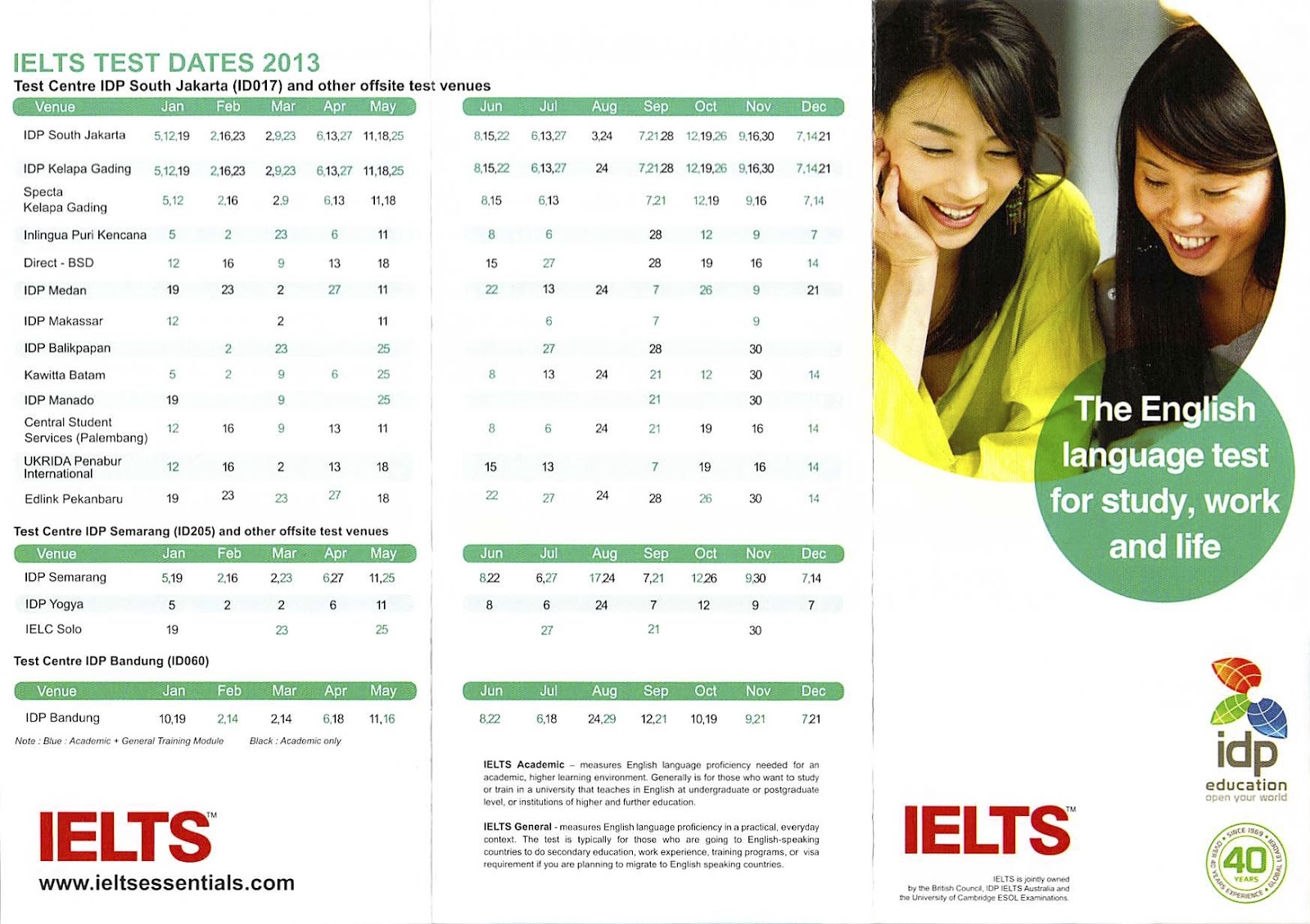
IELTS test dates 2013 - Indonesia

IELTS is the test that opens doors. Whether you're applying to international institutions, employers or immigration authorities, this test could be your 'ticket' to a world of opportunities.
Choose your date and venue, prepare yourself with a workshop or an IELTS coach, and get ready -  'Siap-lah' - to achieve your target score.

Finally, register for your test with the IDP - your partner in educational services.

Thursday, November 29, 2012

Mengapa IELTS?

"K" #1 - KNOW the test : -

What is IELTS? Why take this test? What level is the test? What does the test involve? How useful is it? How is the test structured? How is it different from other standardized English tests like TOEFL?

Check the attached brochure and the website www.ielts.org

IELTS adalah singkatan dari International Language Testing System.

Tes IELTS adalah tes kamampuan bahasa Inggris yang lebih diutamakan di negara2 yang berbahasa Inggris. Negara2 tersebut yaitu Australia, Inggris, New Zealand, Amerika Serikat, Kanada, Singapura, Irlandia, Skotlandia, dan sampai Belanda dan Malaysia juga. Banyak negara yang semakin mengakui keberadaan tes IELTS.

Saat anda ingin melanjutkan sekolah atau berimigrasi ke luar negeri yang berbahasa Inggris, anda akan melengkapi serangkaian persyaratan. Dan salah satu persyaratan adalah tes kamampuan berbahasa Inggris. Dengan bukti dari tes tersebut, kemampuan anda dalam kompetensi Listening, Reading, Writing & Speaking dapat diukur.

Mengapa tes IELTS makin digemari oleh institusi pendidikan luar negeri?

Karena tes IELTS benar2 menguji anda dalam kompetensi tersebut di atas. Berbeda dengan TOEIC yang hanya mengutamakan kompetensi Listening & Reading saja. Berbeda dengan tes TOEFL yang menguji kompetensi anda di Listening, Reading & Writing saja.

Walaupun di tes TOEFL-ibt ada tes Speaking, anda harus berbicara kepada komputer di tes itu. Sedangkan di tes IELTS, anda akan berbicara dengan native speaker di dalam kontext yang lebih realistis di komponen tes Speaking

Mengapa kamu sendiri akan atau sudah memilih tes IELTS?

Wednesday, November 28, 2012

Learning, information and entertainment.

Go to the the Learning English website and sign up for their free newsletter*.

Make learning English easier by watching and keeping yourself informed about their new programs.

Visit their Facebook page: http://www.facebook.com/LearnEnglishAN for daily language tips and to connect with other learners.

English Bites are now also available in Vietnamese http://australianetwork.com/englishbites/s8_viet.htm (including Bahasa Indonesian http://australianetwork.com/englishbites/s8_indo.htm)

And a new series of English Bites based on the popular My Australia program is coming soon.

Keep up-to-date with their weekly posting of re-versioned episodes though their Facebook page or website.

English subtitles will soon be added to these videos - look out for the caption icon on the YouTube player toolbar.

Finally, download the Australia Network app  - stay connected with a path to good entertainment, knowledge, and learning.

*The newsletter will be delivered to you every 6 weeks and keep you up to date with English language programs that will help to improve your English skills.

Writing sample - Task 2

Published regularly on the IELTS-Blog.com website - sample essays for Task 2 with a predicted Band scores.

Suggestions and revisions by an IELTS teacher are also included.

This is a good way to compare and contrast your own writing skills and find your strengths and weaknesses.

Click on this link for a Band score 6, in Task 2 : http://www.ielts-blog.com/ielts-writing-samples/ielts-essays-band-6/ielts-essay-topic-globalization/

Tuesday, November 27, 2012

True, False, Not Given questions

-->
Answering True, False, Not Given questions

Let’s check the meaning of False below.

Dictionary definition of False -  |fôls| adjective -
1 not according with truth or fact; incorrect: the test can produce false results | the allegations were false.
2 deliberately made or meant to deceive: check to see if the trunk has a false bottom | a false passport.
• artificial: false eyelashes.
3 illusory; not actually so: sunscreens give users a false sense of security.

In True/False questions – False actually covers answers that are both False and also Not Given. In order to differentiate, focus on the definition of False and think carefully about the statement.

If a statement is not true according to the text, it is classed as False.

The statement in the question can be False because :
·      it contradicts the information in the text in some way, or
·      there’s no information about the statement in the passage.

A False statement contradicts the information in a passage or text because :
·      it’s the direct opposite of the original text e.g the text says ‘white’, but the statement says ‘black’,
·      it has the negative meaning of the meaning in the original text e.g. ‘light - dark’, ‘north -south’,
·      it’s neither of these, but it’s not the same meaning as the information in the text .


Sunday, November 25, 2012

Reading

The reading test is a test of how quickly you can find answers to the questions. Check the strategies that will help you increase your reading speed and practice them regularly.


Strategies to increase your speed in reading.

ü Skim the title and the questions. They give you a summary of the passage.

ü Skim the text to obtain general information. Think about the general information not the detail.

ü Scan for the specific detail, don’t concentrate on the meaning of the text. If you start to read, you will find it difficult to locate the words your looking for.

ü Skim and read – skim the text, stop at particular points to look at meaning. Use the questions to be your guide or compass around the text.

ü Skim and scan – when you scan a text for a specific word, your eye touches the other information only lightly. Because your focus is on scanning, your eye skims the text naturally and does not slow you down.

ü Read the first sentence of a paragraph and then skim the beginning of each sentence in that paragraph. Ignore and don’t underline words you do not know.

ü Skim the verbs in each sentence. Start at the verb in each sentence and look at everything after that. The verb usually marks the beginning of new information in a sentence.

ü Skim the text to understand the theme. Are there facts or are there ideas?

ü Mark the connecting words (moreover, in addition, however).